Pour-Over Coffee: Percolation Dynamics and Control
Harness gravity and water velocity. Understand flow resistance, paper media retention, channel mitigation, and how grind variance transforms your cup clarity.
The Mechanics of Open Percolation
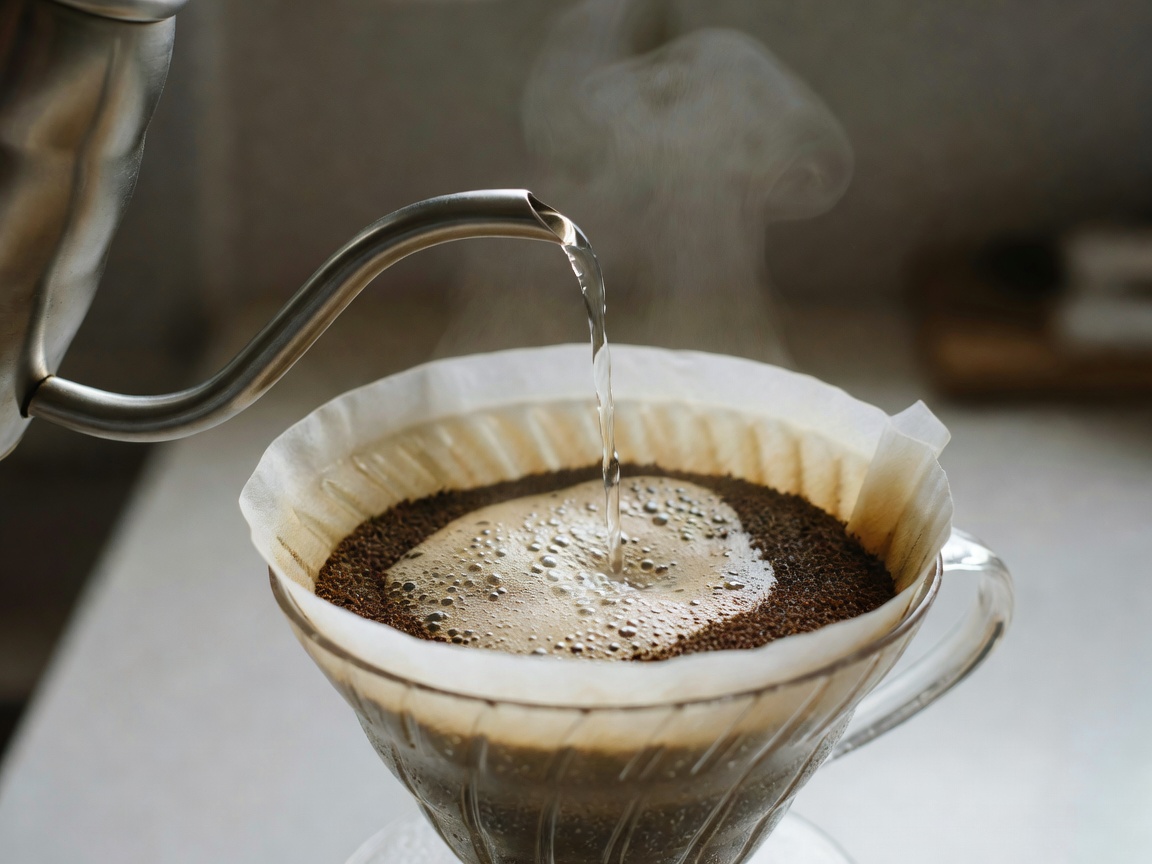
Pour-over brewing is continuous fluid percolation through a porous packed ground bed suspended above an exit orifice. Unlike closed systems, fluid movement is powered strictly by gravitational pull and hydraulic head pressure generated by the liquid volume standing over the coffee bed. Fresh roasted coffee releases volatile gases—chiefly carbon dioxide—which form bubbles that disrupt fluid pathways unless expelled cleanly.
When hot water contacts freshly ground roasted coffee, it initiates the bloom phase. Carbon dioxide trapped within cellular matrices during the roasting cycle escapes aggressively upon saturation. If you rush this phase by continuing to pour, escaping gas pockets deflect water flow outward, creating preferential channels through which water bypasses ground mass without adequate contact time. The standard operational rule is simple: dose water at a 3:1 mass ratio relative to dry coffee weight, ensure uniform saturation across the entire bed diameter, and hold for 40 to 45 seconds before resuming flow.
Grind Micron Sizing and Burr Selection
Pour-over demands a tight particle size distribution centred between 500 and 800 microns. Fine particles (fines under 100 microns) migrate rapidly downward through the bed matrix, clogging the micro-apertures of paper filtration filters. This migration causes sudden drops in drainage velocity, extending drawdown duration and forcing over-extraction of astringent polyphenols.
Utilising high-grade steel conical or flat burr grinders minimises fine production compared to cheap blade choppers, which pulverise beans erratically. If your drawdown stalls past 3 minutes and 30 seconds on a standard 15-gram dose, your grind distribution contains an excess of micro-fines, or your pouring stream is delivering excessive vertical kinetic energy, driving fines into the bottom filter apex.
| Brewer Geometry | Recommended Ratio | Grind Micron Target | Total Contact Time |
|---|---|---|---|
| Conical Dripper (60°) | 1:15 to 1:16.6 (60g/L) | 550–700 µm | 2:30 – 3:15 min |
| Flat-Bottom Wave | 1:16 to 1:17 (58g/L) | 650–800 µm | 2:45 – 3:30 min |
| Thick Wall Chemex Glass | 1:15 to 1:16 (62g/L) | 750–950 µm | 3:45 – 4:45 min |
Geometry: Conical vs Flat-Bottom Beds
Dripper geometry governs the cross-sectional velocity of liquid moving through coffee. In 60-degree conical drippers, water converges toward a single central exit aperture. The central bed depth is significantly thicker than the perimeter edge, meaning central grounds experience prolonged extraction relative to peripheral grounds. Precise circular pouring patterns with a gooseneck kettle are vital to keep water distribution proportional across the varying bed depth.
Flat-bottom drippers feature a horizontal perforated base with three or more exit holes. This structure forces an even cylindrical bed geometry where liquid travels through identical bed depths regardless of whether it enters near the perimeter or the centre. Flat-bottom systems yield narrower extraction spreads and higher overall clarity, making them forgiving for single-pour strategies. Conical drippers, conversely, reward deliberate multi-stage pulsing, enabling distinct accentuation of bright fruit acids and floral aromatics.
Thermal Decay and Kettle Velocity
Water temperature within the slurry is always lower than the temperature registered in the kettle spout. Heat energy transfers rapidly to the ambient atmosphere, the brewer body material (ceramic, glass, or plastic), and the dry grounds. Preheating your brewing apparatus with boiling rinse water is mandatory to avoid catastrophic slurry temperature collapse down to 80°C.
Deliver kettle water with minimal vertical drop. Holding the spout 20 centimetres above the bed introduces excessive turbulence, churning the lower sediment layers and driving fine particles into the paper pores. Keep your spout 2 to 4 centimetres above the fluid level. Maintain a smooth, circular laminar stream, spiralling outward from the centre without ever washing directly against the dry paper perimeter, which provokes instant bypass flow down the brewer ribs directly into the decanter.