AeroPress: Air Displacement and Hybrid Control
Combine full immersion infusion with mechanical air pressure filtration. Fine-tune brew temperature, agitation duration, paper retention, and plunge resistance.
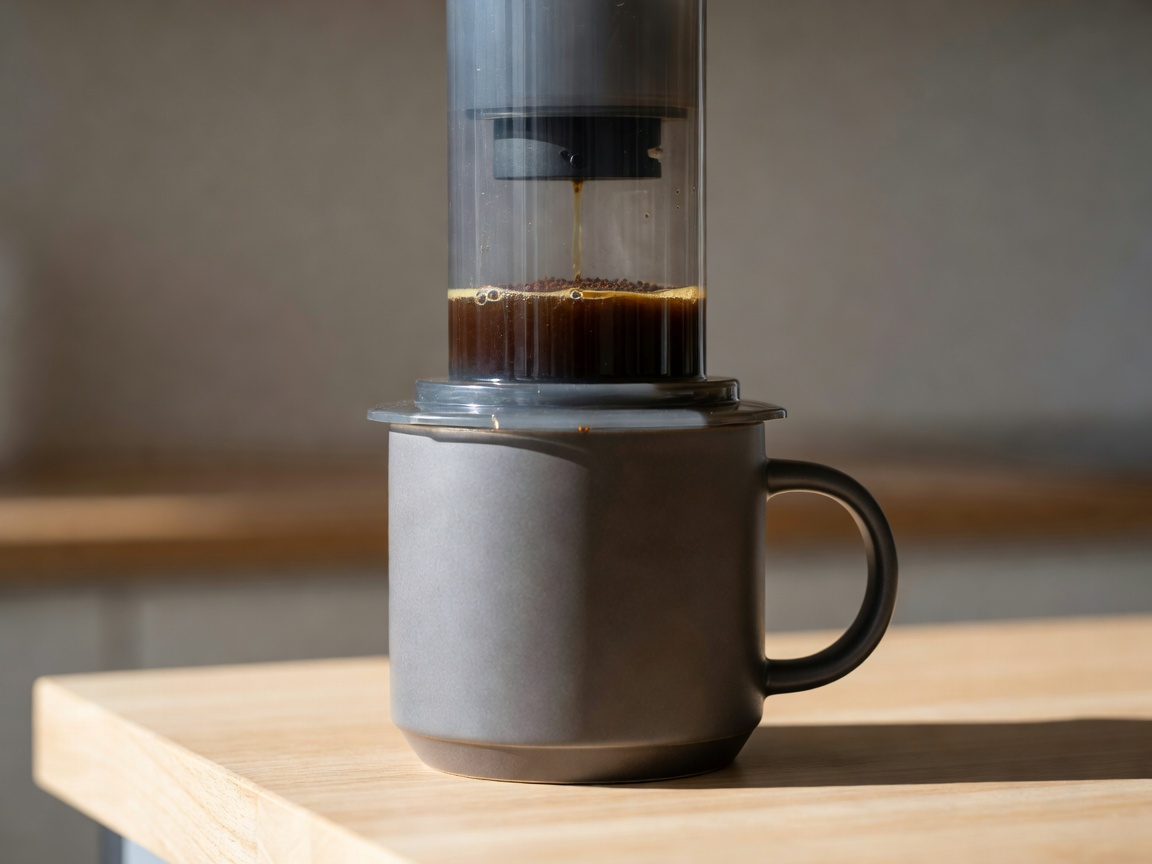
The Hybrid Immersion-Pressure Mechanism
Invented in 2005 by Alan Adler, the AeroPress bridges two extraction paradigms: full immersion steeping and pneumatic pressure filtration. Coffee grounds sit in complete contact with the liquid inside a sealed cylinder. When the elastomer plunger seal is depressed, it compresses a column of trapped air against the liquid slurry. This generates approximately 0.35 to 0.75 bars (5 to 11 psi) of mechanical driving pressure.
This air pressure forces liquid through a dense cellulose paper filter disk or perforated metal disc far more rapidly than gravity alone allows. Because extraction velocity is accelerated manually, you can grind coffee substantially finer than pour-over without suffering prolonged drawdown stalls or channelled water bypass.
Standard vs Inverted Methodologies
In standard upright orientation, water begins leaking through the paper filter immediately upon contact with the grounds, allowing an uncontrolled volume of weak, un-steeped liquid to escape into the serving vessel before the brew timer elapses. Inserting the plunger by 5mm immediately creates a negative pressure vacuum that stops premature dripping, but minor bypass persists during the initial fill.
The inverted method eliminates premature leakage entirely. By standing the AeroPress upside down on the retracted plunger, the cylinder becomes a hermetically sealed immersion chamber. Grounds steep in 100% of the water volume for the entire programmed contact duration. After steeping and gentle stirring, the filter cap is screwed into place, the entire assembly is inverted smoothly onto a sturdy decanter, and the plunge stroke is initiated.
| Recipe Style | Dose / Water | Grind Setting | Steep Duration | Plunge Time |
|---|---|---|---|---|
| Classic Filter Cup | 15.0g / 240g | Medium-fine (550 µm) | 2:00 minutes | 30 seconds |
| Bypass Concentrate | 20.0g / 100g | Fine (350 µm) | 1:15 minutes | 25s (dilute +120g water) |
| Low-Temp Competition | 18.0g / 200g | Medium-coarse (700 µm) | 1:30 min @ 85°C | 40 seconds |
Agitation Kinetics and Water Temperature
Because the AeroPress cylinder is compact, mechanical agitation creates rapid changes in extraction yield. Stirring the slurry with the included paddle breaks the boundary layers surrounding individual coffee particles, accelerating mass transfer of soluble compounds into solution. Three deliberate paddles can raise total dissolved solids (TDS) by over 0.15% in a short 60-second brew cycle.
Water temperature response in the AeroPress is exceptionally wide. While light floral roasts benefit from 92°C to 94°C water to unlock volatile sweetness, dark roasts can be brewed as low as 80°C to 85°C. The pneumatic pressure forces liquid through the bed regardless of thermal kinetic energy, allowing you to sidestep the harsh bitter pyrolytic notes released at near-boiling temperatures without leaving the coffee thin or grassy.
Managing Plunge Pressure and the "Hiss"
When depressing the plunger, apply gentle, uniform forearm pressure. If plunging feels excessively difficult and demands heavy body weight, your grind is too fine, or fine particles have formed a concrete-like barrier across the paper surface. Forcing the plunger violently risks shattering glass carafes or rupturing the elastomer seal.
Stop plunging the moment you hear the audible "hiss" of escaping compressed air contacting the filter screen. Depressing past this point compresses the spent coffee cake directly, squeezing out bitter, high-tannin astringent fluids trapped within the collapsed bed. Stop cleanly, set the chamber aside, and discharge the puck cleanly into a compost receptacle.