French Press: Immersion Kinetics and Sediment Control
Eliminate water bypass completely. Understand steady-state concentration gradients, lipid retention, prolonged infusion cycles, and particle settling mechanics.
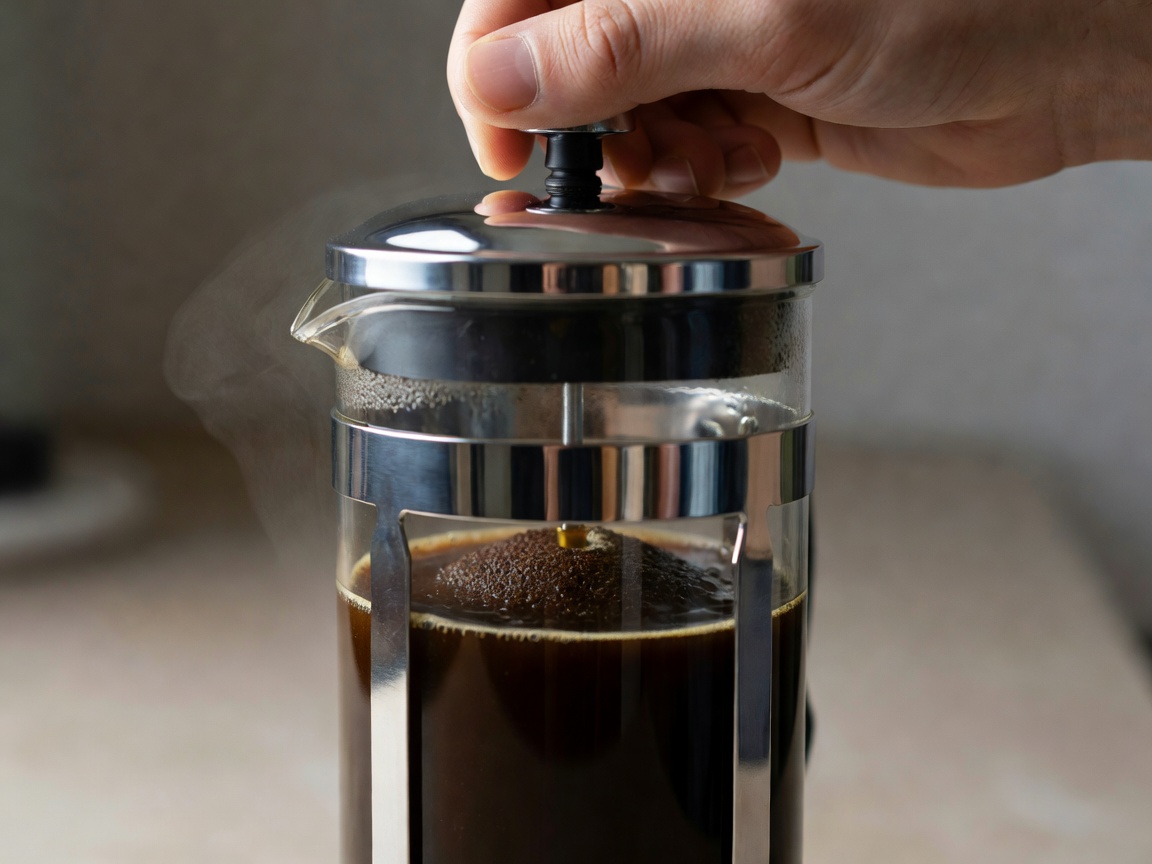
The Zero-Bypass Immersion Advantage
The French press operates on total immersion. In drip percolation, freshwater continually washes over coffee particles, constantly renewing a sharp osmotic gradient. In immersion brewing, all water and all coffee grounds occupy the same vessel simultaneously. As extraction proceeds, the concentration of dissolved solubles in the surrounding liquor rises steadily, causing the rate of dissolution to naturally taper off.
Because there is zero water bypass—every milliliter of added fluid interacts with every particle of dry coffee—French press brewing is extraordinarily uniform. Channelling is physically impossible in an immersion slurry. Variations in particle size do not trigger uneven flow channels as they do in espresso or pour-over, making immersion the most consistent extraction method for evaluating roasted bean characteristics.
Lipid Retention and Mesh Filtration
Paper filters trap cafestol and kahweol: naturally occurring aromatic diterpenes and emulsified oils. The French press utilises a woven stainless steel wire mesh screen (typically 60 to 100 mesh count, filtering down to roughly 150–250 microns). This screen allows suspended microscopic colloidal particles and light oils to enter the decanted beverage.
These suspended solids alter mouthfeel dramatically, coating oral receptors and attenuating perceived sharpness. For consumers seeking deep, heavy body and pronounced chocolate or nutty base notes, immersion mesh filtration is unmatched. However, allowing uncontrolled fine sludge into the cup causes continuous over-steeping while cooling, which introduces astringency unless proper settling techniques are applied.
| Step | Time Target | Mechanical Action |
|---|---|---|
| Thermal Dose | 0:00 | Add 95°C water to dry grounds at 1:15 ratio (60g coffee to 900g water) |
| Crust Break | 4:00 | Stir the top floating bed with two spoons; heavy grounds sink downward |
| Skim Surface | 4:30 – 5:00 | Remove residual foam and floating chaff with spoons to reduce bitterness |
| Sediment Rest | 5:00 – 9:00 | Leave undisturbed; gravity draws fines to the bottom bed |
| Decant | 9:00 | Insert plunger to surface level only; do not plunge down; pour smoothly |
The Modern Extended Immersion Technique
Traditional instructions advise grinding coarse, steeping for 4 minutes, and depressing the plunger with force. This approach yields an under-extracted, murky brew. Because immersion extraction slows as the surrounding water saturates, a 4-minute steep on coarse grounds achieves an extraction yield well under 18%, leaving valuable sweet sugars stranded inside the bean cells.
Adopt the modern extended settling method: grind at a medium-coarse setting (750 to 900 microns). After introducing hot water, let the slurry sit for 4 minutes until a thick coffee crust forms at the surface. Break this crust with a spoon. Most grounds will immediately sink to the bottom of the glass cylinder. Skim off the remaining surface foam and bitter chaff. Now, wait an additional 5 to 7 minutes without plunging. Gravitational settling pulls suspended fines out of the liquid column. When decanting, use the mesh filter merely as a surface barrier against stray grounds. Never compress the sediment cake at the bottom.
Thermal Retention in Glass and Steel
Because the French press requires extended steeping times, thermal dissipation through thin glass walls is substantial. A standard glass carafe can lose up to 12°C across a 10-minute extraction window, dropping the slurry below the efficient extraction threshold.
To preserve thermal momentum, use double-walled stainless steel or heavy vacuum-insulated brewers. If using borosilicate glass, cover the vessel with a thick towel or use an insulated sleeve during the undisturbed settling phase. Retaining heat between 88°C and 92°C through the eighth minute ensures complete dissolution of sweet complex carbohydrates without imparting sour notes.